Self-deception
Great ExpectationsSelf-deception is a recurring mechanism in Pip’s rise from the forge: he mistakes class aspiration and romantic hope for a coherent destiny, then invents respectable-sounding excuses for choices he knows, or later recognizes, to be wrong. The adult narrator’s retrospective corrections make the theme especially sharp. His younger self does not simply misunderstand other people; he constructs a flattering account of his own conduct, and the narrative repeatedly shows how that account collapses under later knowledge.
A change he cannot undo
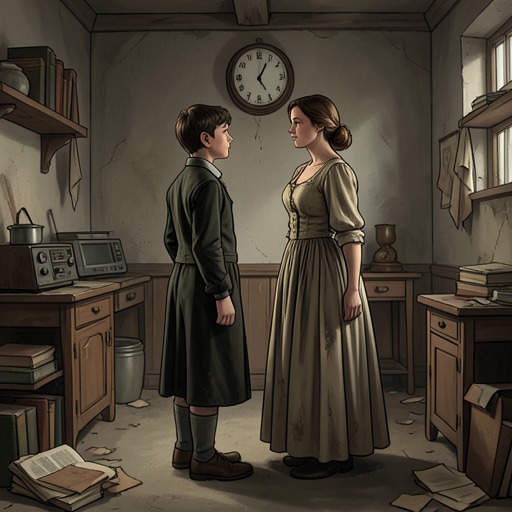
The origins of Pip’s self-deception lie in a change of feeling that he can describe more clearly as an adult than he could understand as a boy. After visiting Miss Havisham and encountering Estella’s contempt, he returns to the kitchen thinking of Joe as a coarse blacksmith, of his boots and hands, and of the difference between domestic life at home and the apparently elevated world of Miss Havisham and Estella. Joe has just warned him against the violent stories he has been reading, but Pip’s thoughts turn instead to how Estella would judge Joe. The contrast reveals the first shape of his shame: he begins to treat the loving home that raised him as an embarrassment before he can admit what that change means.
The adult narrator refuses to reduce that transformation to a single cause. He considers whether his own fault, Miss Havisham’s influence, or his sister’s treatment was responsible, then insists that the change in him had happened regardless. This is not an acquittal. It is a distinction between explaining the conditions that formed his attitude and denying responsibility for what he did with it. The image of the first link in a chain, which might be iron or gold, thorns or flowers, makes one memorable day consequential without pretending its later effects were entirely predictable.
The forge makes the cost of his altered outlook concrete. Before his expectations, Pip had imagined becoming Joe’s apprentice as a distinction and a source of happiness. When the apprenticeship becomes his actual path, he feels only the coal dust and the weight of a future that once seemed his own. He remembers standing in the churchyard on Sunday evenings, comparing his prospects with the low, flat marsh landscape and the dark mist beyond it. Yet he also records one fact in his own favor: throughout his apprenticeship, he never complained to Joe. The qualification is narrow, and its very narrowness exposes how little it can redeem the inward contempt he has developed.
The flattering story of advancement
When Pip learns that he has great expectations, he presents the news to Joe and Biddy as a mysterious patron’s plan and impresses upon them the need to keep the benefactor’s identity secret. Their delight and wonder at his becoming a gentleman do not make him happier. Instead, as Joe and Biddy regain their cheerful ease, Pip grows gloomy and suspects that beneath his satisfaction with his fortune he may be dissatisfied with himself. Even their pleasant looks seem to him like mistrust, although he acknowledges that neither of them has said or done anything to warrant his suspicion. He interprets their affection through the lens of the new status he wants, as if their ordinary kindness were a judgment on him.
His private fantasy about Estella turns hope into a seemingly reasoned prediction. He imagines that Miss Havisham has adopted him in effect as well as Estella, and that he is to restore Satis House, bring light and warmth into its dark rooms, set its clocks going, and marry the woman he loves. The ruined house becomes the stage for his imagined future, with Estella at its center and Pip cast as its romantic hero. The older narrator carefully qualifies the fantasy: he did not give Estella qualities she did not possess; he loved her because he found her irresistible, despite knowing that the attachment opposed reason, promise, peace, hope, and happiness. His retrospective honesty does not make the younger hope less deluded, but it identifies its true basis as an attachment that no practical argument could restrain.
Pip’s self-deception also works through omission. He thinks of his devotion to Estella as a high emotion, yet admits that he never regarded keeping away from Joe because Estella would despise him as low or small. Joe had recently brought tears to his eyes; Pip notes bitterly that those tears dried quickly. The juxtaposition punctures the grand story Pip tells himself about love. His longing for Estella does not erase the social shame that makes him withhold his affection from Joe; rather, the two impulses coexist, and the romantic ideal helps conceal the injury done to the person who has cared for him.
Excuses and false accounts
By the time Pip has become accustomed to his expectations, their effects reach beyond his own self-image. He lives with chronic uneasiness about his behavior toward Joe and an uncomfortable conscience concerning Biddy. At night he sometimes imagines that he would have been happier and better had he never seen Miss Havisham and had instead grown up content to partner with Joe at the forge. Looking at a fire alone, he recognizes that the forge and kitchen fires at home had been better than the world he pursued. This regret is not yet a complete change of conduct: it shows that he can perceive what he has lost while remaining entangled in the life and desires that displaced it.
He also begins to see that his spending has harmed Herbert. Pip’s lavish habits lead his easygoing friend into expenses he cannot afford, disturb the simplicity of his life, and leave him with anxiety and regret. Pip distinguishes Herbert from the other branches of the Pocket family, whose small schemes he regards as natural to them, and feels particular remorse about making Herbert’s rooms more expensive and placing the Avenger at his disposal. The distinction matters: Pip can sometimes perceive the consequences of his privilege, but his recognition is uneven and does not prevent him from imposing its habits on a friend.
That unevenness is stark in his recollection of Joe’s visit to London. Pip finds Joe’s holiday clothes, stiff collars, awkward eating, dropped food, and uncertain movements embarrassing, and he is impatient with him. Joe responds with kindness rather than reproach. Only afterward does Pip understand that Joe’s discomfort was not an innate failure of gentility: if Pip had been more at ease with him, Joe would have been more at ease with Pip. His adult account turns the scene into a moral reversal. The awkwardness he attributes to Joe is partly produced by Pip’s own coldness, which makes their meeting painful for the man who has come to see him.
The exposure of the lie
After a visit from Joe, Pip resolves that he should return to their town and stay at Joe’s home. But once he has secured a place on the coach and completed other errands, he begins making excuses to stay at the Blue Boar instead. He tells himself that he would inconvenience Joe, that his bed might not be ready, and that Miss Havisham might require him nearby. The adult narrator identifies these arguments as self-deception, likening them to passing off nutshells as banknotes: unlike a person cheated by someone else, Pip knows the false value of what he is giving himself and chooses to accept it as real. He does not merely fail to find the truth; he actively manufactures a pretext that lets him avoid facing it.
The pattern persists when he recognizes Orlick as an unsuitable man for a trusted position at Miss Havisham’s. Pip tells his guardian, who readily agrees to dismiss him, and then becomes alarmed by how summarily the matter will be handled. Even when his judgment of another person is sound, Pip’s understanding of his own motives remains compromised by his willingness to treat his new social position and its arrangements as natural. The narrative does not make every judgment false; it shows instead that accurate perceptions can coexist with an evasive self-account.
The revelation that the convict is Pip’s benefactor destroys the central story he has built around his expectations. He learns that Miss Havisham did not intend him for Estella: he had been a convenient instrument in her dealings with her greedy relatives and a model on whom to practise emotional cruelty. Yet the deepest pain is not simply the loss of his imagined future. Pip thinks of the convict, whose crimes he does not know and who may be taken from the room and hanged at the Old Bailey, and recognizes that he has deserted Joe for the sake of a false prospect. This belated ordering of his injuries exposes how thoroughly his self-deception had made status and romantic hope seem more important than loyalty.
Pip says he would not return to Joe or Biddy, not because they have rejected him, but because he feels the shame of his own conduct too intensely to accept the comfort their fidelity could offer. His sense of unworthiness now blocks the very reconciliation it might otherwise have prompted. The adult narrator can name the deception, but naming it does not undo its consequences: he cannot reverse the years of distance he created by treating his own invented future as more real than his obligations.
Retrospective correction and moral significance
The adult Pip’s narration makes self-deception more than a flaw confined to the younger character. He repeatedly separates what he once believed from what he can now admit: the shame of home, the meaning he assigned to Estella, the motives hidden beneath his apparent gratitude, and the excuses with which he evaded Joe. This structure gives the reader knowledge the young Pip lacks while also preventing the older narrator from claiming innocence. His explanations are corrections, not erasures. He can identify the pressure of Miss Havisham’s influence or the pain of his childhood circumstances without pretending that these factors make his treatment of Joe and Biddy harmless.
The theme’s governing irony is that Pip wants to become a gentleman but repeatedly mistakes appearance and social elevation for moral improvement. His fantasies allow him to imagine himself as the rescuer of Satis House and the destined partner of Estella; his excuses allow him to avoid Joe without admitting that he is ashamed of Joe’s class. Yet the conduct that matters most—his ingratitude, his coldness, and the harm his spending does to Herbert—survives beneath those attractive stories. The narrative’s eventual force comes from watching those stories fail one by one, and from the painful difference between knowing that one has deceived oneself and having already acted on the deception.
Self-deception is therefore bound to memory and consequence. Pip’s adult voice revisits the choices of his youth not to make them seem inevitable, but to show how a false account of the self can turn affection into embarrassment, ambition into a measure of worth, and avoidable injury into something that seems justified. His retrospective honesty begins the work of moral recognition; it cannot restore the first link, or make the chain of its consequences disappear.